About the author — Naveen Kumar is the founder of MedFlowX, a dental-only SEO agency. He has built search strategies for orthodontic practices. More about how we work.
That's the opportunity and the problem for orthodontic practices. The demand is real and growing, but it lands in Google first — on searches like "Invisalign near me," "adult braces [city]," and "how much do clear aligners cost." If your practice doesn't appear for those searches, a competitor does, and the patient never knows you existed.
This guide is the practitioner's playbook for orthodontic SEO in 2026: what it actually is, the keyword layers that capture treatment intent, how to win the local map pack, the content an ortho site needs to rank, and how to get cited inside Google's AI Overviews. It is written for the orthodontist or practice owner who wants to understand the strategy — not a patient brochure.
- What is SEO for orthodontists, and why does it matter in 2026?
- Why do orthodontists need different SEO than general dentists?
- What keywords should an orthodontic practice target?
- How do orthodontists win the local map pack?
- What content does an orthodontic website need to rank?
- How do orthodontists get cited in Google AI Overviews?
- How long does orthodontic SEO take to work?
- SEO vs Google Ads for orthodontists — where should the budget go?
What is SEO for orthodontists, and why does it matter in 2026?
SEO for orthodontists is the work of getting an orthodontic website to rank in Google's organic and map results for the searches patients use when looking for braces or clear aligner treatment in a specific city. It combines local SEO, treatment-specific service pages, and supporting content — and it puts a practice in front of high-intent patients without paying for every click.
It matters more in 2026 than it ever has because of who the orthodontic patient now is. The classic model — a pediatric dentist refers a twelve-year-old, the parent books, treatment starts — still exists, but it is no longer where the growth is. The growth is the 34-year-old who has wanted to fix their smile for a decade and just decided to do it. That patient has no referring dentist in the loop. They open Google, search "clear aligners [their city]," read for three weeks, compare a handful of practices, and book the one that earned their trust online.
The numbers behind that shift are not subtle. According to Grand View Research (2026), the U.S. clear aligner market alone was valued at roughly $3.87 billion in 2025 and is growing at a compound annual rate near 29% — one of the fastest-growing categories in all of healthcare. Demand at that scale, concentrated in a treatment patients self-refer for, makes search the primary battleground for orthodontic practices. Whoever owns the local search results owns the pipeline.
The practices that treat SEO as optional are competing for the shrinking referral pool while the self-referred aligner market flows to whoever ranks. That is the strategic stakes of orthodontic SEO in 2026: it is not a marketing nicety, it is the channel the fastest-growing patient segment uses to choose a provider.
Why do orthodontists need different SEO than general dentists?
Orthodontic SEO is narrower and more treatment-driven than general dental SEO because the money searches are organized around procedures and patient segments, not around a broad "dentist near me" query. An orthodontic site wins by having a deep, dedicated page for each treatment and each segment — not by being a generalist that mentions braces on a services list.
A general dental practice ranks for a wide, shallow set of terms: "dentist near me," "teeth cleaning," "emergency dentist," "dental crowns." The intent is broad and the patient often just wants the nearest competent option. Orthodontics is the opposite. The searches are specific, high-consideration, and high-value: a single comprehensive case is worth $4,000 to $7,000, and patients spend weeks deciding. That changes what the SEO has to do.
Three differences matter in practice. First, treatment depth wins. A page titled "Orthodontics" that lists braces, Invisalign, and retainers in three sentences each will lose to a competitor with a full, standalone page on each. Google rewards the site that demonstrably understands "Invisalign for adults" over the one that mentions it in passing. Second, the patient segments split the market. "Adult braces" and "braces for teens" are different searches, with different anxieties and different content needs, and they deserve different pages. Third, the cost question dominates. In orthodontics more than almost any dental category, the highest-volume searches are about price — and most practices refuse to answer them, leaving the ranking open.
"Every orthodontic practice I audit has a services page that lists Invisalign in one line and then wonders why it doesn't rank for it. Invisalign is not a line item — in 2026 it is the practice's single largest growth driver. It needs its own page, its own cost content, and its own internal link structure. The practices that treat each treatment as a full topic are the ones taking the market." — Naveen Kumar, Founder, MedFlowX
What keywords should an orthodontic practice target?
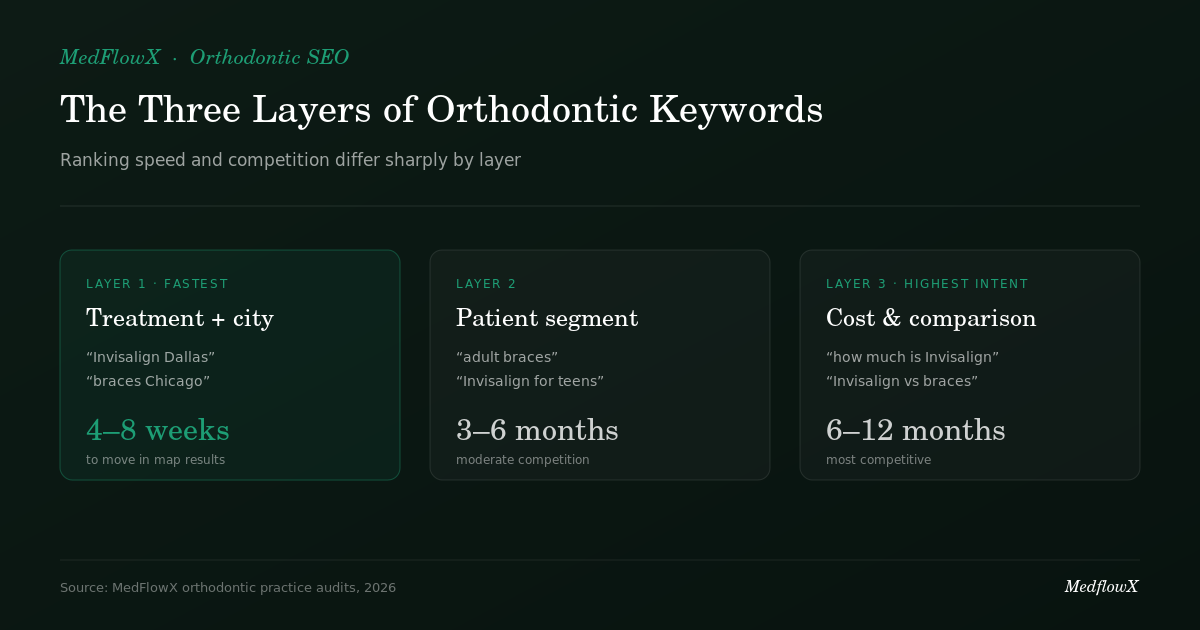
An orthodontic practice should target three keyword layers: treatment-plus-city terms, patient-segment terms, and cost-and-candidacy questions. Treatment-plus-city terms ("Invisalign Dallas," "braces Chicago") carry the highest commercial intent; cost questions carry the highest volume and the least competition because most practices won't answer them.
Here is how the three layers break down, with the role each plays in the funnel:
- Treatment + city (commercial intent) — "Invisalign [city]," "braces [city]," "clear aligners near me," "orthodontist [city]." These are the patients ready to choose a provider. They are the most competitive terms and the ones your treatment service pages must rank for. Each treatment gets its own optimized page.
- Patient segment (consideration intent) — "adult braces," "Invisalign for teens," "clear aligners for adults," "braces for adults [city]." These searches reflect a specific patient identity. A 40-year-old searching "adult braces" wants to know they won't be the only grown-up in your waiting room. Segment pages convert because they speak to a specific anxiety.
- Cost & candidacy (research intent, highest volume) — "how much do braces cost," "how much is Invisalign," "am I a candidate for Invisalign," "Invisalign vs braces." This is where the volume lives and where most practices have no page at all. Answering the cost question honestly, with your market's real ranges, is the single biggest ranking opportunity in orthodontic SEO.
The cost layer deserves emphasis because it is so consistently neglected. "How much does Invisalign cost" and its city variants generate enormous, durable search volume, and the practices that publish honest, contextual pricing content capture it — while practices that say "call for a quote" remain invisible during the exact phase when the patient is deciding. We cover the full strategy in our guide to building an Invisalign pricing page that wins patients, and the same principle applies to braces and clear aligners.
One more distinction matters: "Invisalign" and "clear aligners" are not interchangeable in search. Invisalign is the brand patients know, but "clear aligners" captures the cost-conscious and comparison-shopping segment. A complete orthodontic keyword strategy targets both, plus the "vs" searches where patients weigh their options — covered in our breakdown of winning both patient segments with an Invisalign vs braces strategy.
How do orthodontists win the local map pack?
Orthodontists win the local map pack by optimizing their Google Business Profile, building review velocity, and maintaining consistent citations across directories. The map pack — the three local results with the map above the organic listings — captures the majority of clicks for "near me" and "[treatment] [city]" searches, making it the highest-leverage real estate in local orthodontic search.
The mechanics matter because the map pack is where local intent converts. According to BrightLocal, local map listings receive roughly 67% of clicks on local searches, and the conversion rate for patients who arrive through local search is far higher than any other channel. For an orthodontic practice, ranking in the top three of the map pack for "orthodontist [city]" or "Invisalign [city]" is often worth more than ranking #1 organically.
Three factors drive map rankings, and a practice can influence all three. The first is your Google Business Profile itself: the correct primary category ("Orthodontist," not "Dentist"), complete service listings, treatment-specific photos, and regular posts. The second is review velocity and recency — not just the total count, but a steady flow of recent, detailed reviews that mention treatments by name ("got my Invisalign here"). With 96% of consumers reading reviews before choosing a provider (BrightLocal, 2025), this is both a ranking factor and a conversion factor. The third is citation consistency: your name, address, and phone number identical across every directory Google cross-references.
We cover the full optimization process in our Google Business Profile guide for dental practices — every principle there applies directly to an orthodontic practice, with the one adjustment that your primary category and review language should center on orthodontic treatments rather than general dentistry.
See where your orthodontic practice ranks right now
We'll audit your current rankings for braces, Invisalign, and clear aligner searches in your city — and show you exactly which patients you're missing.
Get Your Free Orthodontic SEO Audit →What content does an orthodontic website need to rank?
An orthodontic website needs a dedicated service page for each treatment, segment pages for adult and teen patients, and supporting content that answers cost and candidacy questions. The structure matters as much as the writing: Google rewards practices whose content forms a connected cluster around each treatment, not a set of disconnected pages.
At minimum, a competitive orthodontic site in 2026 should have the following content, organized as topic clusters with internal links connecting each supporting article back to its treatment page:
- Treatment service pages — a full, standalone page for Invisalign, traditional braces, and clear aligners, each 1,500–2,500 words covering the treatment, candidacy, process, timeline, and what makes your practice the right choice. These target the commercial "[treatment] [city]" searches.
- Cost guides — honest, market-specific pricing content for each treatment. This is the highest-volume, lowest-competition opportunity. A patient who reads your braces cost guide and your Invisalign cost guide trusts you before they ever call.
- Segment pages — "Adult braces" and "Orthodontics for teens," each speaking to that patient's specific concerns. Adults worry about appearance and professional life; parents worry about compliance and cost.
- Comparison content — "Invisalign vs braces," "clear aligners vs Invisalign," "Invisalign vs braces cost." These capture the comparison-stage patient and link into your treatment pages.
- Candidacy and process content — "Am I a candidate for Invisalign," "how long does treatment take," "what to expect." These answer the questions that stand between research and booking.
The depth standard is non-negotiable. A 400-word page that says "we offer Invisalign, contact us to learn more" will not rank against a competitor with a 2,000-word treatment page, a cost guide, and a comparison article all linking together. Google's systems read that cluster as evidence the practice genuinely owns the topic. The single page reads as a brochure. The investment is in building the cluster — and it is exactly the kind of structured build a focused Invisalign SEO engagement is designed to produce.
How do orthodontists get cited in Google AI Overviews?
Orthodontic practices get cited in Google AI Overviews and AI assistants by answering specific patient questions directly, in the first sentences of a clearly-titled section, backed by named sources and specifics. AI engines pull the most direct, self-contained answer to a question — so the content that gets cited is the content that answers "how much does Invisalign cost in [city]" in two clear sentences, not the content that buries the answer under a paragraph of throat-clearing.
This matters because the patient research journey increasingly starts with an AI answer. When a prospective patient asks ChatGPT or Google's AI Overview "is Invisalign worth it for adults," the engine summarizes and cites a handful of sources. Being one of those cited sources puts your practice in front of the patient at the very start of their research — the AI equivalent of ranking #1.
The tactics are concrete. Phrase your section headings as the questions patients actually ask. Open each section with a direct, two-sentence answer before you elaborate. Use real specifics — your city, your treatment names, real price ranges, real timelines — because vague language ("costs vary," "many patients") does not get cited. Add FAQ schema to every treatment and cost page so the structured questions are machine-readable. And cite credible data where it strengthens the answer. These are the same answer-engine principles that earn citations across dentistry; applied to orthodontic cost and candidacy questions, they put your practice in the AI answer before a competitor gets there.
How long does orthodontic SEO take to work?
Orthodontic SEO produces local map movement within 4 to 8 weeks and competitive organic rankings within 4 to 8 months. Local rankings respond fastest because Google Business Profile optimization and review velocity move quickly; organic rankings for terms like "Invisalign [city]" take longer because they require content depth and accumulated authority that builds over months.
The honest timeline looks like this. In the first one to two months, with Google Business Profile optimization and a steady flow of recent reviews, a practice can start appearing — and climbing — in the local map pack. In months two through four, newly published treatment and cost content begins to index and rank for longer-tail searches ("how much do clear aligners cost in [city]"). By months four through eight, the competitive commercial terms ("Invisalign [city]") start moving as the content cluster matures and earns links. After that, the asset compounds.
That compounding is the entire point. A Google Ads campaign delivers patients only while the budget runs; the day you stop paying, the patients stop. An orthodontic page that ranks delivers consultations every month, indefinitely, at no incremental cost — and grows more valuable as it accumulates authority and links. The practices that started their SEO eighteen months ago are now harvesting consultations their competitors are paying $8 a click to chase.
"The most common thing I hear from orthodontists is 'we tried SEO for two months and nothing happened.' Two months is when local rankings start to move and content is barely indexed. The practices that win are the ones that understood SEO as a six-to-twelve-month build that then pays out for years — not a switch you flip for a quick result." — Naveen Kumar, Founder, MedFlowX
SEO vs Google Ads for orthodontists — where should the budget go?
SEO and Google Ads solve different problems for orthodontic practices, and the right answer is usually a sequence, not a choice. Google Ads buys immediate visibility at a high and recurring cost per click; SEO builds a durable asset that produces consultations indefinitely once it ranks. The cost-effective strategy uses ads to capture demand while SEO matures, then shifts budget toward organic as the cost per acquired patient falls.
The economics make the case. Dental and orthodontic keywords are among the most expensive in all of Google Ads — according to WordStream (2026), dentistry sits near the top of every industry, with an average cost per click around $8.00 and specialty terms running higher. A practice can spend real money buying clicks for "Invisalign [city]" every single month forever, or it can invest in ranking organically for the same term and stop paying per click once it does. Over a two-year horizon, the organic route wins decisively on cost per patient.
But ads have a real role, especially at two moments: launching a new practice with no rankings yet, and filling short-term capacity. The smartest orthodontic practices run paid search to capture demand now while their SEO is being built, then taper the ad spend as organic rankings take over the same searches. We break down the full trade-off in our SEO vs Google Ads comparison for dentists — and if you are leaning toward paid search in the near term, our dental PPC strategy guide covers how to run it so it actually converts.
The bottom line for an orthodontic practice: ads are how you buy patients today; SEO is how you stop having to. In a market growing toward $27 billion, the practices building the durable asset are the ones who will own their city's search results when the paid-click arms race gets even more expensive.
Find the orthodontic searches you're missing
We'll pull the exact braces, Invisalign, and clear aligner searches happening in your city, show you who ranks for them today, and map the path to taking those rankings.
Get Your Free Orthodontic SEO Audit →Frequently asked questions
What is SEO for orthodontists?
SEO for orthodontists is the practice of getting an orthodontic website to rank in Google's organic and map results for the searches patients use to find braces and clear aligner treatment in a specific city. It combines local SEO, treatment-specific service pages, and supporting cost and candidacy content. Done well, it puts the practice in front of high-intent patients without paying for every click.
Do orthodontists need different SEO than general dentists?
Yes. Orthodontic SEO is narrower and more treatment-driven. The money searches are organized around procedures (braces, Invisalign, clear aligners) and patient segments (adult vs. teen), not a broad "dentist near me" query. An orthodontic site needs a deep, dedicated page for each treatment plus content that answers the cost questions that dominate the aligner research journey.
How long does orthodontic SEO take to work?
Local map rankings can move within 4 to 8 weeks with Google Business Profile optimization and review velocity. Competitive organic rankings for terms like "Invisalign [city]" typically take 4 to 8 months of consistent content and link building. The asset then compounds — a ranked page produces consultations every month at no incremental cost.
What keywords should an orthodontic practice target?
Target three layers: treatment-plus-city terms ("Invisalign Dallas," "braces Chicago"), patient-segment terms ("adult braces," "Invisalign for teens"), and cost or candidacy questions ("how much do braces cost," "am I a candidate for Invisalign"). Cost searches carry the highest volume and the least competition, because most practices have no page answering them.
Is SEO or Google Ads better for orthodontists?
They solve different problems. Google Ads buys immediate visibility at a high cost per click — useful for launching or filling short-term capacity. SEO builds a durable asset that produces consultations indefinitely once it ranks. The most cost-effective approach uses ads to capture demand while SEO matures, then shifts budget toward organic as the cost per acquired patient drops.