Almost every guide to ranking for “dentist near me” treats the map pack as the finish line. Get into the top three, the reasoning goes, and the phone rings.
It does not work that way. Having listened to enough client call recordings and read enough enquiry forms, the pattern is consistent and slightly uncomfortable: somewhere between 40% and 60% of people who open a practice profile never call anyone. They found you. They looked. They left.
So this guide covers both halves. What actually decides map pack position, and — the part most practices never see — what happens in the fifteen seconds after a patient taps your listing, and where you lose people you have already won.
- What happens after someone searches “dentist near me”?
- What do patients actually look at on your listing?
- Where do practices lose patients they have already won?
- What actually moves your map pack position?
- What can one hour a week realistically hold?
- When does doing it yourself stop working?
- Which local SEO spending is wasted?
What happens after someone searches “dentist near me”?
The behaviour is more predictable than most practice owners expect. A patient searches, the map pack appears, and they open the top three listings. Sometimes a fourth or fifth if something about the first ones feels off — too far away, no recent reviews, photos that look like they belong to a different decade.
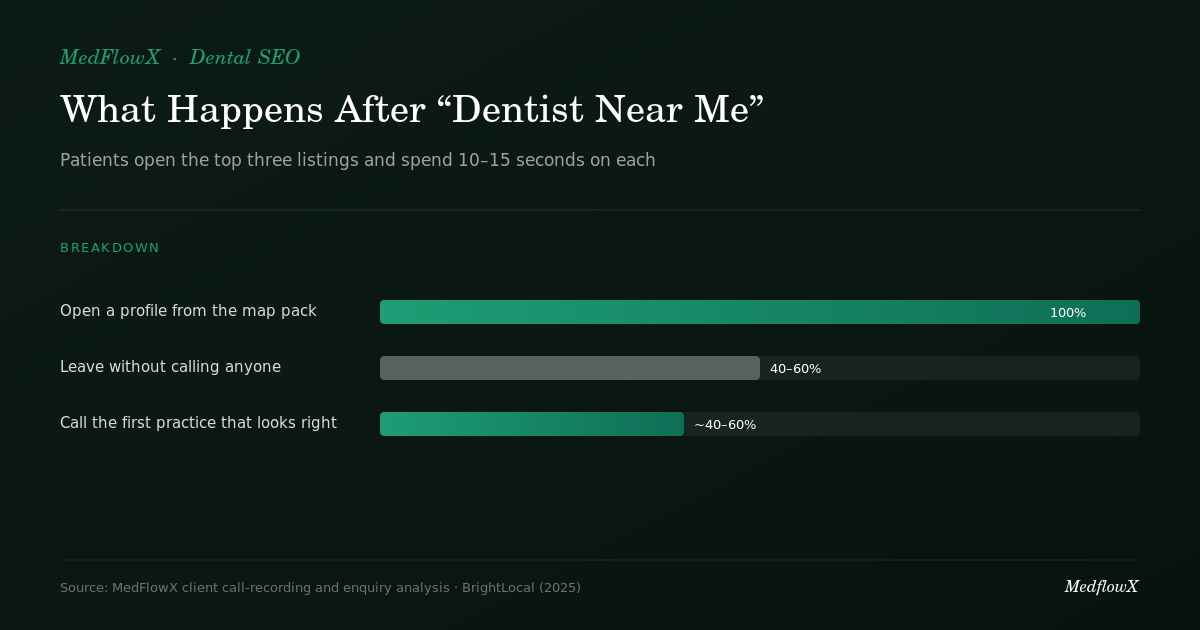
Then they spend roughly ten to fifteen seconds on each profile. Not minutes. Seconds.
The scale of what rides on that is easy to understate. According to BrightLocal (2025), local map listings capture roughly two-thirds of clicks on local searches — more than the organic results beneath them. And according to BrightLocal (2025), 96% of consumers read reviews before choosing a provider, which is why review recency does more work on that profile than almost anything else on it.
Between 40% and 60% of patients who open a profile bounce without calling anyone. The ones who do call usually pick the first practice that does not set off an alarm bell — not the best practice, the first inoffensive one.
That last point is worth sitting with, because it reframes the whole exercise. Patients are not comparing clinical quality. They cannot assess it from a phone screen in fifteen seconds. They are running a rapid elimination: does anything here look wrong? The practice that wins is frequently just the first one that passes.
Which means ranking high is only useful if the profile itself survives those fifteen seconds. A number-one listing with stale photos and reviews that stopped eight months ago will lose the patient to the number-three listing that looks alive.
What do patients actually look at on your listing?
Patients check three things, in roughly this order: how recent the reviews are, whether the photos look like a practice that exists today, and whether the phone number is easy to tap. None of it is clinical, and all of it is judged in seconds.
- How recent the reviews are. Not the star rating — the dates. Patients read the newest reviews first. A 4.9 average built two years ago reads as less trustworthy than a 4.6 with three reviews from last month.
- Whether the photos look like a practice that exists today. Current waiting room, current treatment rooms, actual staff. Patients treat dated photography as a signal that the practice is stuck in time — and by extension, that the dentistry might be too. According to Google, businesses with photos receive 42% more requests for directions and 35% more click-throughs to their website than businesses without.
- Whether the phone number is easy to hit on a phone. Most of these searches happen on mobile. If calling requires effort, a meaningful share of people simply do not.
None of that is technical. None of it requires an agency. And all of it is invisible to a practice owner who only ever sees their own listing on a desktop, logged into their own Google account, where everything looks fine.
Where do practices lose patients they have already won?
Four drop-off points account for most of it: photos that are years old, reviews that stopped months ago, a website that loads slowly on mobile, and no way to reach anyone outside office hours. Each one is fixable in an afternoon, and each one is losing you patients who already found you.
- Photos that are years old, or none added recently. The single most common trust killer, and the cheapest to fix.
- Reviews that stopped months ago, even where the star rating is still strong. Recency is read as evidence the practice is busy and cared-for.
- A website that loads slowly or looks messy on mobile. Plenty of patients click through from the map pack, dislike what loads, and close the tab. That patient is counted as a click and never as an enquiry, so most practices never learn it happened.
- No clear way to reach anyone outside normal hours. A significant share of these searches happen in the evening. If the only option is “call us tomorrow,” tomorrow they will call someone else.
This is where practices quietly lose patients they have already paid to win — through years of SEO, through review campaigns, through everything that got them into the top three in the first place. The website elements that decide conversion matter just as much here as the ranking does.
Does your profile survive fifteen seconds?
We audit your Google Business Profile the way a patient sees it on a phone — review recency, photo currency, and the drop-off points costing you calls you have already earned.
Get Your Free Practice Audit →What actually moves your map pack position?
Ranking for near-me searches is decided almost entirely by your Google Business Profile, not your website. That surprises practice owners who have been paying for website work and wondering why the map pack has not moved.
Four things carry most of the weight:
- Proximity to the searcher. The one factor you cannot change. “Near me” is resolved to wherever the patient is standing, which is why your ranking is not one number — it differs street by street.
- Category accuracy. Your primary category does more work than almost anything else, and precision beats breadth. This is also the setting most commonly broken by well-meaning changes. According to Google, businesses with complete profiles are 70% more likely to attract location visits.
- Review volume and, more importantly, recency. A steady monthly cadence outperforms a larger total that stopped. Consistency beats volume.
- Name, address and phone consistency across directories. Inconsistencies create ambiguity, and ambiguity suppresses local ranking.
- How consistently the profile is updated. This is the factor practices most often miss, because it looks like housekeeping rather than SEO. It is not. A profile receiving new photos, posts, answered questions and current hours reads as an active, maintained business. One that has not been touched in eight months reads as dormant — and dormant listings drift down regardless of how good the reviews were when they stopped.
Update cadence is the most underrated ranking factor in local dental search. Practices treat photos and posts as marketing decoration. Google treats them as evidence the business is still operating — and patients read them the same way.
It compounds with everything else on the list, which is why it matters more than its individual weight suggests. Consistent updating keeps categories accurate because you are looking at them. It keeps hours right because you check. It surfaces the duplicate listing or wrong phone number early, while it is still a five-minute fix. The practices that lose ground rarely do so because of one bad decision — they drift, quietly, over a year of nobody logging in.
Notice what is absent from that list: blog volume, keyword density, backlinks. Those matter for organic rankings below the map, and the two are often confused. Our guide to Google Business Profile optimisation covers the profile mechanics in full, and local SEO for dentists covers how the map pack and organic results interact.
What can one hour a week realistically hold?
If a practice has no budget for an agency and one hour a week, the answer is not to attempt everything badly. It is to protect the basics properly. Here is how that hour is best spent.
| Time | Task | What it protects |
|---|---|---|
| First 20 min | Google Business Profile: add two or three real photos — waiting room, treatment room, actual staff. Reply to every new review. Check the Q&A. Confirm hours and categories are still correct. | Photo currency, review engagement, category accuracy |
| Next 20 min | Ask for reviews properly. No complicated system — a simple ask after a good appointment with the direct link. Track how many you ask versus how many arrive. | Review velocity, the strongest controllable signal |
| Last 20 min | Either fix one name, address or phone inconsistency that keeps appearing, or write one short useful answer to a question patients already ask. | Citation consistency, or content depth |
That is the honest ceiling of a do-it-yourself approach: you can hold a decent top-three position in a moderately competitive area, and keep conversion healthy. What you will not do is outrun a practice that is properly resourced and working the channel every week.
The other limitation is recovery. When something goes wrong — an algorithm update, a competitor turning aggressive, a profile that has drifted — clawing back position at one hour a week is slow.
When does doing it yourself stop working?
Three points, fairly clearly: when you are stuck in positions four to seven and need the top three, when the profile has been neglected for months, and when there is a technical problem an hour a week cannot touch. At that stage the patients you are not getting cost more than a retainer would.
- You are stuck in positions four to seven and need to break into the top three. Holding a position and gaining one are different jobs requiring different effort.
- The profile has been neglected for months and looks stale. Restoring it is a project, not a weekly task.
- There is a technical mess — wrong primary category, duplicate listings, a slow website — that an hour a week cannot touch.
At that stage the new patients you are not getting cost more than a sensible retainer. That is the whole calculation, and it is worth running honestly rather than by instinct — our DIY versus agency comparison and the ROI calculator both exist for exactly that decision.
Which local SEO spending is wasted, and how do practices go backwards?
Three things recur across practice after practice: paid premium directory listings, review-gating tools, and agency retainers that produce reports but never touch the photos, the review process or the citations. None of the three move map pack position.
- Paid “premium” directory listings. They do nothing for map pack position. The citation value of a directory does not increase because you paid for a badge.
- Review-gating tools — anything that filters unhappy patients away from leaving public reviews. These eventually get profiles in trouble with Google, and the downside is far worse than the upside.
- Agency retainers that produce reports and blog posts but never touch the photos, the review process, or the citations. The monthly deck looks impressive and the map pack does not move.
A practice that went backwards
Practices do lose ground, and most of the time it is self-inflicted. One case has stayed with me.
The practice was sitting comfortably at number one or two in its map pack. It brought in a new agency and handed over the Google Business Profile. The agency changed the primary category to something broader, stripped out several secondary categories, and replaced the real practice photos with generic stock-looking images.
Within a couple of months they had fallen to positions five to eight and the phone had stopped ringing the way it used to. Restoring the original categories, putting real recent photos back, and rebuilding review velocity took the better part of three months to recover most of it.
Nothing about that was an algorithm update or a competitor outspending them. It was three well-intentioned changes to a profile that was already working. The lesson practice owners take from it is usually the right one: if your map pack position is healthy, be extremely careful about who is permitted to change your profile, and keep a record of the categories and photos you had before anyone touches it.
It is also a reminder of the wider point. Ranking is the start. Whether the patient still trusts you once they have found you is the rest — and that half is almost entirely within your control.
Frequently Asked Questions
What practice owners ask about near-me visibility.
Near-me rankings are decided almost entirely by your Google Business Profile, not your website. The factors that move position are proximity to the searcher, category accuracy, review volume and recency, how consistently the profile is updated, and consistent name, address and phone details across the web. Proximity you cannot change. The rest you can — and most practices stuck in positions four to seven are losing on review recency and an unmaintained profile rather than anything technical.
Usually one of three things: they are physically closer to the searcher, their primary category is more precise than yours, or their reviews are more recent. Star rating matters less than most practices assume. A practice with 60 reviews arriving steadily will typically outrank one with 200 reviews that stopped eighteen months ago — patients read the newest reviews first, and recency reads as an activity signal.
There is no threshold number, and chasing one is the wrong frame. Review velocity — a steady monthly cadence of new reviews — consistently outperforms a larger total accumulated years ago. A practice adding four or five reviews a month will generally beat a competitor sitting on a stale hundred. Consistency beats volume.
Yes, and it is the factor practices most often dismiss as housekeeping. A profile receiving new photos, posts, answered questions and accurate hours reads as an active business. One untouched for eight months reads as dormant, and dormant listings drift down regardless of how strong the reviews were when they stopped arriving. Update cadence also compounds — practices that log in weekly catch wrong categories, duplicate listings and outdated hours while they are still small problems.
Yes, within limits. One focused hour a week — real photos, review responses, accurate hours and categories, a consistent review ask — will hold a top-three position in a moderately competitive area. Do-it-yourself stops working when you are stuck in positions four to seven and need to break into the top three, when the profile has been neglected for months, or when there is a technical problem like a duplicate listing or wrong primary category that an hour a week cannot fix.
Yes, and most losses are self-inflicted. Changing your primary category to something broader, removing secondary categories, or swapping real practice photos for stock imagery can move a practice from the top two to positions five to eight within a couple of months. Recovery is slower than the fall — restoring categories, real photos and review velocity typically takes around three months to claw most of it back.
About the author — Naveen Kumar is the founder of MedFlowX, a dental-only SEO agency. He has audited digital marketing setups across general, cosmetic, implant and orthodontic practices in competitive US markets. The patient-behaviour patterns in this guide come from reviewing client call recordings and enquiry data across those audits, not from third-party research.
See what your listing looks like to a patient
Free audit covers your map pack position by area, review recency against local competitors, photo currency, and the mobile drop-off points costing you calls.
Get Your Free Practice Audit →