About the author — Naveen Kumar is the founder of MedFlowX, a dental-only SEO agency. He has run neighbourhood-level search audits across Pacific Heights, the Marina and SoMa. More about how we work.
I audited a Pacific Heights implant practice paying $4,500 a month for 14 months. Their agency targeted "dental implants San Francisco" and never built a page for "dental implants Pacific Heights" or any neighborhood term their patients actually used. Those terms had almost no competition — the practice was invisible for searches its best patients made three blocks away.
SF dental local SEO works differently from other US markets. Neighborhood keywords beat city-wide terms in both ranking speed and conversion rate. Yelp matters more here than anywhere else in the country. And 71% of your patients are searching on an iPhone — a number that shapes everything from page load requirements to review strategy. If you work with a dental SEO agency for San Francisco practices, this is what they should be building for you.
- Why do city-wide keywords fail SF dental practices?
- Which SF neighborhoods have the best opportunity?
- Does Yelp affect Google rankings in SF?
- What does 71% iPhone usage mean for your site?
- How many touchpoints before an SF patient books?
- What do top-ranking SF practices actually do?
- How long does dental SEO take in San Francisco?
Why do city-wide keywords fail San Francisco dental practices?
Here is the counterintuitive truth about San Francisco dental SEO: the keywords every practice is targeting are not the keywords that will move the needle fastest.
"Dentist San Francisco" has strong search volume — and so does every established practice, DSO, and well-funded competitor in the city. The top 3 positions for that term are occupied by practices with 5–8 years of domain authority, hundreds of backlinks, and thousands of reviews. A practice with a 2-year-old domain cannot displace them in 90 days regardless of how good the SEO is.
Meanwhile, "dentist Pacific Heights" gets searched hundreds of times a month by patients who already know what neighborhood they want. "Invisalign Marina District" is searched by young professionals who live there. "Dental implants SoMa" is typed by tech workers who want to book near their office. These terms have meaningful search volume — and almost no dedicated competition. The practices with neighborhood-specific pages rank on page 1 for them without a fight.
"74% of SF dental websites have generic, thin content targeting broad city-wide keywords. Almost none have neighborhood-specific treatment pages — the exact terms with the fastest ranking potential and the highest conversion rates."
The paradox: the keywords that feel most important — "dental implants San Francisco" — are the hardest to rank for and take the longest. The keywords that feel less important — "dental implants Pacific Heights" — are the easiest to rank for and convert at higher rates, because patients searching at neighborhood level are closer to booking. The right SF dental SEO strategy starts with neighborhood terms and builds toward city-wide terms as domain authority grows — not the other way around.
Which San Francisco neighborhoods have the best dental SEO opportunity?
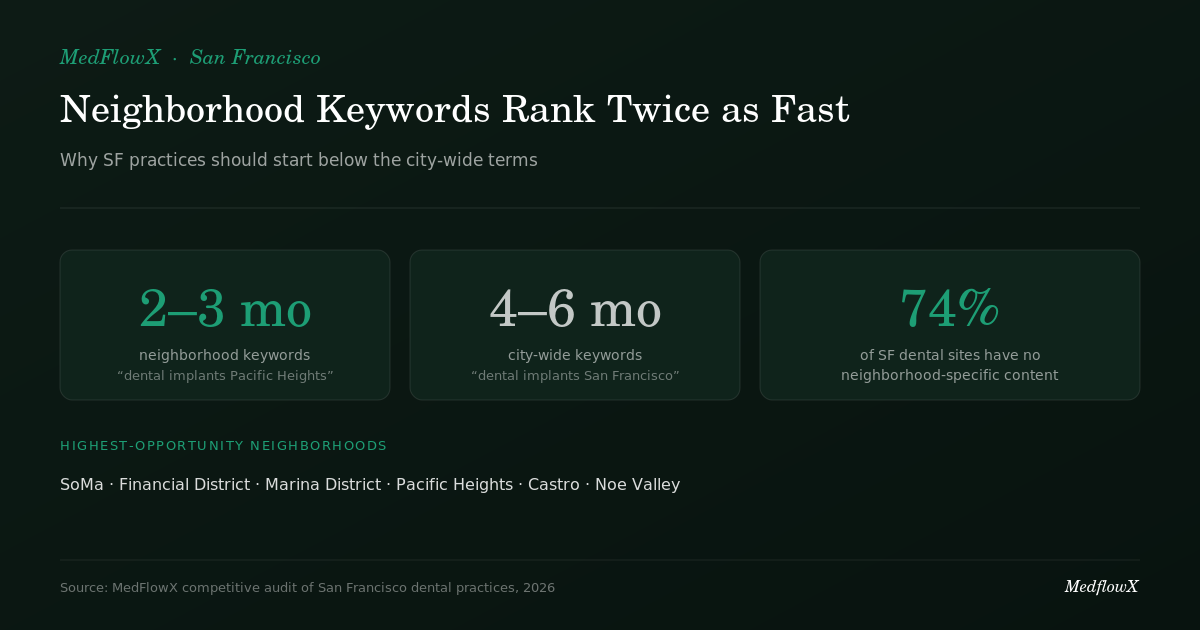
Not all SF neighborhoods are equal from a dental SEO standpoint. The opportunity varies significantly by income concentration, competition density, and search behavior. Here is how the major neighborhoods break down for dental practices:
The playbook for each neighborhood is the same: build a dedicated treatment page targeting the neighborhood-level keyword, optimize the Google Business Profile service area to include the neighborhood, and generate reviews that mention the neighborhood by name. That last point matters more than most practices realize — a review that says "best dentist in the Marina" is a geo-signal Google reads directly.
Does Yelp affect Google rankings for San Francisco dentists?
Yelp was founded in San Francisco in 2004. It still has its strongest user engagement there by a wide margin. This has a concrete effect on dental SEO that practices outside the Bay Area never need to think about: in San Francisco, Yelp review velocity is a trust signal that Google uses to validate local business prominence. Practices with strong Yelp profiles consistently outperform identical competitors in Google Maps rankings across the Bay Area.
This is not true in Houston. It is not true in Dallas. It is not meaningfully true in most US cities. But in SF — and to a lesser extent Oakland and Berkeley — ignoring Yelp while optimizing Google is like running one-legged. Your Google Maps ranking will underperform your content quality because Google is looking at a weak Yelp footprint and discounting your prominence score.
A dual Google + Yelp review strategy for an SF dental practice looks like this:
- Every patient gets asked for both a Google review and a Yelp review — not one or the other. The in-chair script routes patients to Google if they have a Google account and to Yelp if they are active Yelp users.
- Yelp reviews are responded to within 24 hours. Yelp's algorithm weights recency of owner responses as a quality signal for their own rankings — and those rankings feed back into Google's local prominence calculation.
- The Yelp business profile is fully built out with the same keyword-rich service descriptions used on the website. Yelp profiles that match the website's treatment terminology get stronger co-citation signals from Google.
- Yelp Elite users in the practice's neighborhood are worth cultivating — their reviews carry significantly more weight in Yelp's algorithm than standard user reviews.
The practices that rank in the SF Map Pack for competitive terms almost always have strong Yelp profiles. It is not a coincidence.
How does your SF practice rank right now?
The free audit shows your Google Maps position, Yelp review velocity, and the neighborhood keywords your competitors are ranking for — with a specific action plan for your location.
Get Your Free SF Practice Audit →What does 71% iPhone usage mean for your dental website?
71% of local dental searches in San Francisco happen on iPhone. This is higher than the national average and significantly higher than markets like Houston or Dallas. SF patients are walking between meetings, checking Google Maps from the Muni, or searching while waiting for coffee. The practice they find is the one that loads fast, reads clearly on a phone, and has a booking button visible above the fold.
I audited a Nob Hill cosmetic practice last year with a genuinely beautiful website — great photography, strong reviews, solid content. They were getting around 300 organic clicks a month and converting 4 of them into bookings. The problem was their site took 4.2 seconds to load on an iPhone. Not broken — just slow. We rebuilt it for mobile speed. Same traffic, same content, same keywords. The next month they had 19 bookings from the same 300 clicks. Nothing changed except how fast the page loaded on the device 71% of their patients were using.
In SF your mobile site is your site. A booking button buried below the fold, a phone number that isn't tappable, a before/after gallery that doesn't load on mobile — each of these is a patient who found you and left without calling. Google sees that behaviour and ranks you lower. The practices winning the SF Map Pack have sites that open fast, show a tap-to-call number immediately, and let a patient book an appointment before their Muni stop arrives.
How many touchpoints does an SF patient take before booking?
The average SF dental patient completes 7–9 online touchpoints before booking an appointment. In Houston, that number is 3–4. In a rural market, it may be 2. The difference is income, education, and the culture of research that the Bay Area tech workforce brings to purchasing decisions — including healthcare.
Those touchpoints typically look like this: Google Maps search, read 3–5 reviews on Google, click the website, read about the dentist, check Yelp, read more reviews, visit the treatment page, look at before/after photos, check insurance, book or call. Ten steps. And a practice that is missing any of these pages or signals loses the patient at that step — silently, with no indication it happened.
This is why thin content fails completely in SF. A practice page that says "We offer dental implants in San Francisco. Call us today." does not survive the 7-touchpoint journey. The patient hits that page, finds nothing to read, and goes back to Google.
The practice that wins has a treatment page that explains what to expect, what it costs, how the procedure works, and why their practice is the right choice — written for a patient who is going to read it carefully, probably twice, before deciding. In SF that is not optional. It is the price of entry for high-value cases.
"SF patients spend 7–9 online touchpoints before booking — versus 3–4 in smaller US markets. Every missing page, thin treatment section, or unanswered Yelp review is a place the patient exits your funnel and books with a competitor."
For implant and Invisalign practices this is especially important. A patient considering a $5,500 Invisalign case or a $6,000 implant is not going to book with a practice whose website has two paragraphs about the procedure. They will book with the practice whose site answers every question they have, shows them before/after results, and has 80 reviews at 4.9 stars. Content quality and review volume are your closing arguments in the SF market.
What do top-ranking San Francisco dental practices actually do?
After auditing SF dental practices across Pacific Heights, the Marina, SoMa, and the Castro, the pattern in the top-ranking practices is consistent across five areas:
- Neighborhood treatment pages exist and are real. Not thin pages with location names swapped in — actual pages with neighborhood-specific content, local references, and treatment information tailored to what that neighborhood's patients search for. "Dental implants Pacific Heights" is a different page from "dental implants Marina District" in every measurable way.
- The Google Business Profile is managed as an active channel. Updated weekly with posts, new photos every 2 weeks, service categories fully populated, Q&A section answered. The practices at the top of Google Maps in SF treat their GBP the way a good practice manages its social media — consistently and with real content.
- Review velocity on both Google and Yelp is sustained. Not a burst of 30 reviews at launch and nothing for 6 months — consistent new reviews every week. The top-ranking SF practices average 3–6 new reviews per week across both platforms. A Castro practice we work with went from 12 reviews to 67 in 4 months by training the front desk to ask every patient before they left the chair — not via email follow-up, which converts at 8%, but in person, which converts at 34%.
- Treatment content goes deep. The implant page is not 400 words. It covers the procedure, the cost, the timeline, the recovery, financing options, and before/after results. It is written for a patient who is going to read it. The practices that rank and convert in SF have pages that answer every question a high-research patient asks before booking.
- Local citations are consistent across 40+ directories. Name, address, phone number — exactly the same across Google, Yelp, Healthgrades, Zocdoc, the SF Chamber of Commerce directory, Bay Area neighborhood directories, and dental association listings. Citation inconsistency is a common technical failure in SF practices that otherwise have strong content.
How long does dental SEO take in San Francisco?
SF is a high-authority market. The realistic timeline for dental SEO in San Francisco is longer than in smaller US cities — but the payoff is proportionally larger because the patient value is higher and the market is deeper.
| Milestone | Timeline | What drives it |
|---|---|---|
| Page 1 — neighborhood keywords | 2–3 months | Neighborhood pages built, GBP optimized, 25+ reviews live |
| First Google-sourced patient calls | Month 3–4 | Neighborhood rankings converting, GBP driving Map Pack clicks |
| Page 1 — city-wide terms | 4–6 months | Domain authority building, content depth, backlinks accumulating |
| Map Pack — city-wide | 5–8 months | Review velocity, GBP authority, citation consistency across 40+ directories |
| 20+ organic leads/month | Month 6–8 | City + neighborhood rankings both producing, compounding content |
| Full market dominance | Month 10–14 | Deep content library, strong backlink profile, 100+ reviews, neighborhood authority |
Targeting only city-wide terms from day one, expecting page 1 results in 60 days, quitting at month 4 when neighborhood rankings are already working but city-wide terms haven't arrived yet. Month 4 in SF is when most of the real gains are 30–60 days away. Practices that quit there hand their neighborhood rankings to whoever outlasts them.
The SF dental market rewards patience and punishes impatience. A practice that starts neighborhood SEO in June and stays consistent through December will own those neighborhood rankings going into January — the highest-volume dental search month of the year, driven by insurance resets. The practices scrambling to start SEO in November to capture January traffic are 6 months behind.
If you want a specific picture of where your SF practice stands right now — your current Map Pack position, Yelp review velocity relative to top competitors, and which neighborhood keywords are your fastest wins — the free dental SEO audit gives you that in 48 hours with competitor data from your specific SF neighborhoods.
Frequently Asked Questions
What SF dental practices ask before starting a local SEO campaign.
Neighborhood-level keywords like "dentist Pacific Heights" or "Invisalign Marina District" typically rank within 2–3 months. City-wide terms like "dental implants San Francisco" take 4–6 months. SF is a high-authority market — domain strength matters more here than in most US cities. Practices that start with neighborhood keywords while building domain authority for city-wide terms see the best overall timeline.
In San Francisco, yes more than almost any other US city. Yelp review velocity is a trust signal Google uses to validate local business prominence. SF patients are disproportionately Yelp-active — the platform was founded in SF and still has its strongest engagement there. Practices with strong Yelp profiles consistently outperform identical competitors in Google Maps rankings across the Bay Area. A dual Google + Yelp strategy is essential in SF in a way it simply isn't in Houston or Dallas.
SoMa and the Financial District are currently the highest opportunity neighborhoods for dental SEO. High search volume from the tech workforce, but almost no neighborhood-specific dental content exists online. Pacific Heights and the Marina are competitive but worth targeting for implants and cosmetic. The Castro and Noe Valley are strong for general dentistry and Invisalign with lower competition than you'd expect given their income demographics.
Google Ads in SF cost $7–$12 per click for dental keywords — among the highest CPCs in the country. For implant and Invisalign practices, a modest paid budget ($800–$1,200/month) makes sense while SEO builds. For general dentistry, the economics are harder to justify. The practices that do best in SF use SEO as the primary acquisition channel and Ads as a short-term bridge in months 1–4, then scale Ads back as organic rankings kick in.
Three things: income, device, and research depth. SF patients have among the highest median incomes of any US dental market, which means higher willingness to pay for premium treatment and less price sensitivity. 71% of local dental searches happen on iPhone — your mobile experience is not optional. And the average SF patient completes 7–9 online touchpoints before booking — versus 3–4 in smaller markets. Content quality and review volume matter more in SF than almost anywhere.
See exactly where your SF practice stands
Free audit covers your Map Pack position, neighborhood keyword gaps, Yelp review velocity vs competitors, and a specific action plan for your SF location.
Get Your Free Practice Audit →