About the author — Naveen Kumar is the founder of MedFlowX, a dental-only SEO agency. He has audited dental practice marketing setups across general, cosmetic, implant and orthodontic clinics in competitive US markets. More about how we work.
Sometime in January 2026, a practice owner opens Search Console and notices new-patient form fills have quietly dropped for six weeks. Nothing changed on the site — no bad reviews, no new competitor. Impressions for terms that used to rank page one, like "dental implants [city]," have simply thinned out with no single event to point to.
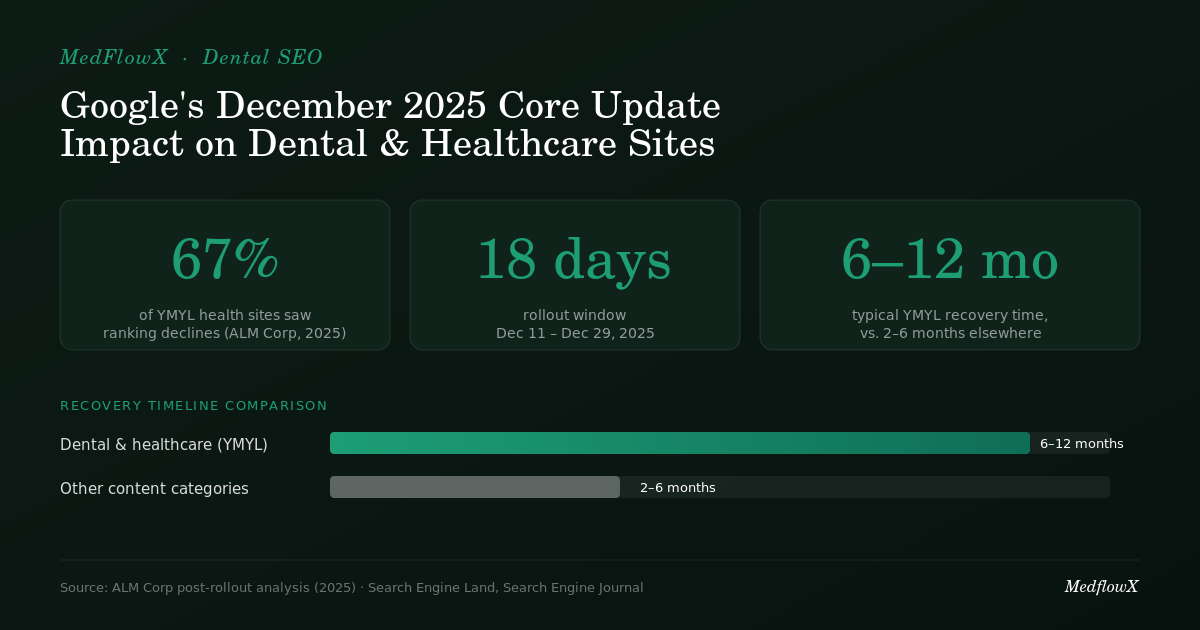
That pattern traces to a specific date. Google's December 2025 core update rolled out over 18 days, from December 11–29 — the third broad core update of the year. According to post-rollout analysis from ALM Corp (2025), it hit health, medical, and financial content hardest, with roughly two-thirds of YMYL ("Your Money, Your Life") sites reporting negative ranking impact.
Dental content sits inside that category. Here's what actually changed, why dental practices were hit harder than most, and what separates the sites recovering from the ones still bleeding traffic seven months later.
- What happened in Google's December 2025 core update?
- Why did dental and healthcare websites get hit harder than other industries?
- How can you tell if your practice's site was affected?
- What kind of dental content lost rankings — and what kind held steady?
- What should a dental practice do now to protect or recover rankings?
- How does this connect to AI Overviews and where dental search is headed?
What happened in Google's December 2025 core update?
Google's December 2025 core update raised the quality bar Google applies to E-E-A-T — experience, expertise, authoritativeness, and trustworthiness — and extended standards that used to apply mainly to YMYL content across nearly every category. It was the third core update of 2025, following updates in March and June, and it rolled out fast: rank-tracking tools like SEMrush's volatility sensor spiked to 7.8 out of 10 within the first 48 hours, and webmaster forums filled with reports of 40–70% overnight traffic drops before the update had even finished rolling out.
Glenn Gabe, an SEO consultant widely followed for his core-update analysis, noted that YMYL sites — particularly finance and health — were "among the first to experience major movement," describing the early days of the rollout as a signal of how confident Google had become in its expanded quality-evaluation systems. That confidence showed up as a wider net: tech blogs, recipe sites, and travel guides that had never worried about E-E-A-T before found themselves evaluated by the same expertise-and-experience standards Google previously reserved for content that could affect someone's health or finances.
For an industry like dentistry, already inside the YMYL perimeter, the update didn't introduce a new standard so much as enforce the existing one with real consequences for the first time.
What actually moved wasn't a single ranking factor Google flipped on. Core updates work by re-running the entire evaluation of how well a page satisfies a query, using improved systems for judging expertise and trustworthiness signals — things like who wrote a page, whether they've demonstrated real experience with the subject, and whether the site as a whole behaves like a credible source rather than a content farm. Nothing about this is a penalty in the old sense of a manual action against a specific site. It's a recalculation, applied all at once, of which pages Google's systems now believe deserve to rank — and for dental content specifically, that recalculation leaned hard on the presence (or absence) of a real, named professional behind what's published.
Why did dental and healthcare websites get hit harder than other industries?
Dental content is evaluated against Google's strictest quality standards because it touches patient health decisions — the same YMYL classification applied to medical and financial advice. According to ALM Corp's analysis (2025), 67% of health and YMYL sites reported a negative ranking impact from the December update, and the sites hit hardest were consistently the ones without clear, named professional-credential authorship.
The pattern repeated across every YMYL vertical the analysis tracked. Medical information sites without physician bylines lost rankings for symptom and treatment queries. Financial advice pages without certified-professional credentials saw similar declines. The through-line wasn't topic sensitivity on its own — it was the absence of a demonstrable, named expert standing behind the content. A dental blog post explaining "how dental implants work" with no author, no credentials, and no clinical review reads to Google's current systems exactly like the medical and financial pages that lost rankings for the same reason.
There's a genuinely useful flip side to this, and it's easy to miss if you only read the decline numbers. According to the same analysis, well-credentialed health and medical sites didn't just hold steady — many gained visibility as lower-quality competitors around them lost ground. Sites with named, credentialed authors, clear editorial oversight, and regularly reviewed content moved up specifically because the field around them thinned out. For a private practice willing to put a real name and real credentials behind its content, this update is less a threat than a redistribution of visibility away from anonymous, generic competitors.
The practical version of this in dental search looks like the difference between two pages both targeting "how much do dental implants cost." One is a generic explainer with a national price range, no author, and language that could describe implants in any country on earth. The other names the treating dentist, cites the practice's own case range with a specific city's cost of living factored in, and explains what actually drives the variation — bone grafting needs, implant material, single-tooth versus full-arch. Both pages might have been ranking fine in November 2025. Only one of them was built to survive December.
How can you tell if your practice's site was affected?
Compare Google Search Console impressions and clicks for the 60 days before December 11, 2025 against your most recent 60 days. A broad, gradual decline that starts inside that window — not a sudden drop tied to a single page change or a technical error — points to the core update rather than something you did.
- Pull the before/after GSC comparison first. Export impressions and clicks for Oct 12–Dec 10, 2025 against the most recent 60-day window, filtered by page and query, and look for a decline that begins around mid-December rather than a specific date you changed something.
- Cross-check with a third-party rank tracker. GSC data lags, sometimes by weeks, so a tool like SEMrush or Ahrefs gives a faster read on whether specific keyword positions actually moved during the rollout window.
- Check whether the decline is site-wide or page-specific. A drop concentrated on one or two pages usually means a content or technical problem with those pages. A broad decline across most of your blog and service pages is the signature of an algorithmic reassessment.
- Look at which pages held up. If your treatment pages with named-dentist review held steady while generic blog posts declined, that's strong internal evidence the update — not a technical issue — is the cause.
Worth noting: this pattern isn't limited to individual practice websites. We pulled ranking data on content from several well-known dental marketing agencies in the weeks after the update, using Ubersuggest's keyword-coverage tracking on their published guides. One agency's flagship "complete guide to dental SEO" article — broad, unauthored, written in the generic style common across the industry — still holds a reduced but meaningful footprint. A companion listicle-style article from the same agency did not: it went from roughly 55–60 tracked ranking keywords before the rollout to just 5 low-volume keywords by mid-2026, with almost no visibility left in the top 10. Even agencies whose entire business is dental SEO are not exempt from this — generic, credential-less content lost ground regardless of who published it.
What kind of dental content lost rankings — and what kind held steady?
Content that reads interchangeably with any other industry — generic guides, unauthored "ideas" listicles, thin service descriptions — lost the most ground. Content with a named, credentialed voice and genuine specificity held steady or gained. The dividing line wasn't length or keyword optimization; it was whether a real person's expertise was visible on the page.
| Content type | What happened | Why |
|---|---|---|
| Generic "ultimate guide" articles, no named author | Lost the majority of rankings | Reads interchangeable with any industry — no credential or experience signal |
| "X ideas" listicles | Rankings collapsed hardest | Thin per-item depth, no first-hand evidence behind any point |
| Named-dentist patient education content | Held or gained visibility | Clear expertise signal, answers real clinical questions directly |
| Case studies with real outcomes and dates | Held or gained visibility | Demonstrates a result, not just a claim |
| Treatment pages with clinical specificity | Mostly stable | Answers the patient's actual question with genuine depth, not filler |
Not sure if your site was hit — or why?
We'll pull your Search Console data against the update window, check your content and authorship signals against what's currently ranking, and show you exactly what changed.
Get Your Free Audit →What should a dental practice do now to protect or recover rankings?
Start with authorship and credential signals, since that's the single factor most consistently correlated with post-update recovery. Then close content-depth gaps with genuine clinical specificity. Technical fixes — site speed, mobile experience, HTTPS — matter, but they're a smaller lever for YMYL content than the expertise signal itself.
- Put a named, credentialed dentist on every clinical piece of content. A byline with the doctor's name, license, and a short bio is the single clearest E-E-A-T signal a practice can add, and it costs nothing to implement.
- Build a real "About" and editorial-standards presence. A page explaining who reviews content, how often it's updated, and the practice's clinical credentials gives Google (and patients) a trust anchor beyond individual articles.
- Replace generic claims with specific, checkable detail. "Implants can restore your smile" tells Google nothing about expertise. "We've placed implants for patients ranging from single-tooth cases to full-arch All-on-4 reconstructions, with healing timelines typically running 3–6 months depending on bone density" demonstrates it.
- Add real outcomes with real numbers and dates. Case studies and before/after content with specific timeframes and results are exactly the kind of experience-based evidence this update rewards.
- Keep the technical baseline solid. HTTPS, fast mobile load times, and a clear privacy policy won't rescue thin content, but they remove friction that compounds an existing authority problem.
Be honest with yourself about the timeline. Because dental content sits inside YMYL, recovery is typically slower here than for other categories — 6 to 12 months for substantial recovery is the norm cited in post-update analysis, compared to 2 to 6 months for lower-stakes content. That's not a reason to panic-rewrite everything overnight; it's a reason to prioritize the pages with the most traffic potential first, fix the authorship and depth problems properly, and expect steady, not immediate, movement.
Sequence matters more than most practices assume. Fix your highest-traffic pages first, not your newest ones — a service page that used to bring in twenty organic form fills a month is worth far more attention than a blog post that never ranked well to begin with. Within each page, add the credential and authorship signals before you touch anything else; that single change is the one most consistently tied to recovery in the post-update data. Only after authorship and depth are fixed does it make sense to spend time on secondary work like internal linking between your treatment pages and your blog content, or refreshing the publish dates on pages that haven't been touched since 2024. Practices that do this in the wrong order — technical polish first, credentials last — are consistently the ones still waiting for recovery months later.
"Every dental site we've reviewed since December has the same tell: articles with no name attached, written to sound like they could be about any medical field with a find-and-replace. That's not a content problem you fix with more words — it's a credibility problem you fix by putting a real dentist's name and real clinical judgment behind what's published. The practices that already did that before December are the ones that didn't need to panic in January." — Naveen Kumar, Founder, MedFlowX
How does this connect to AI Overviews and where dental search is headed?
The same signals Google rewards in this core update — named expertise, genuine experience, specific and checkable detail — are what determines whether a page gets cited inside an AI Overview. Industry tracking in 2026 puts AI Overviews on a large majority of informational dental search queries, and generic, credential-less content is exactly the kind of source AI Overviews summarize and route around rather than cite.
That makes this update less of a one-time event to recover from and more of a preview of where dental search is heading. Google's own 2026 guidance on AI Overviews and AI Mode confirms they run on the same core ranking systems this update reinforced — there's no separate "AI SEO" checklist to chase. The practices building genuine, credentialed, specific content now aren't just protecting their current rankings; they're building the exact profile that gets named as a source when a patient asks an AI assistant "which dentist in my city does implants." That's the same foundation our dental SEO service is built around, and the same editorial standard behind every guide on this blog — named authorship, real numbers, and no filler.
If you want a second opinion on where your own site stands against these standards — and whether last December's update is part of why your numbers have shifted — that's exactly what our content strategy framework and free audit are built to answer.
See exactly where your rankings stand post-update
We'll compare your site against the credential and content-depth signals this update rewards, and show you what to fix first.
Get Your Free Growth Audit →Frequently asked questions
What was Google's December 2025 core update?
It was Google's third broad core update of 2025, rolling out over 18 days from December 11 to December 29. It raised the bar for how Google evaluates E-E-A-T (experience, expertise, authoritativeness, trustworthiness), extending standards previously focused on YMYL content across nearly every content category, with health, medical, and financial sites affected most.
Why were dental and healthcare websites affected more than other industries?
Dental content falls under Google's YMYL classification because it touches patient health decisions, so it's evaluated against stricter credential and experience standards. According to post-update analysis, 67% of health and YMYL sites reported negative ranking impact, with sites lacking named professional-credential authorship losing the most ground.
How long does it take a dental practice to recover from a core update ranking drop?
Typical recovery for YMYL sites like dental practices runs 6 to 12 months for substantial recovery, longer than the 2 to 6 months seen in lower-stakes categories. Google takes a more cautious approach to re-establishing trust in health-adjacent content, so consistent, credentialed content work matters more than fast rewrites.
Does dental blog content need to be written or reviewed by a licensed dentist to rank well?
It doesn't need to be written entirely by a dentist, but it needs a visible, named dentist's credentials behind it — as author, clinical reviewer, or both. Content with no named expert attached is consistently the content that lost the most visibility in the December 2025 update.
How can I tell if my practice's website was affected by the December 2025 update?
Compare Search Console impressions and clicks for the 60 days before December 11, 2025 against your most recent 60 days. A gradual, broad decline starting in that window — rather than a drop tied to one specific page change — points to the core update rather than a technical issue on your site.