About the author — Naveen Kumar is the founder of MedFlowX, a dental-only SEO agency. He has audited dental practice marketing setups across general, cosmetic, implant and orthodontic clinics in competitive US markets. More about how we work.
Chicago is a harder dental market to rank in than its size suggests, and the reason is structural rather than competitive in the ordinary sense. This is DSO country. Dental service organizations operate more multi-location groups here than in almost any comparable US metro, and those groups own the city-wide search terms that independent practices instinctively chase first.
The result is a market where a good independent practice can spend two years and a substantial budget trying to rank for “dentist Chicago” and never crack page two — while the neighborhood terms its actual patients use sit almost entirely uncontested.
Chicago is also not one market. The Loop and Naperville behave like different countries in search, and a single “Chicagoland” page serves neither. If you are evaluating a dental SEO agency for a Chicago practice, that distinction should come up before they quote you.
- Why is Chicago dental marketing a DSO fight?
- Which Chicago neighborhoods have the best opportunity?
- Should you target the city or the suburbs?
- Are “dental marketing Chicago” and “dental SEO Chicago” different?
- When should you publish seasonal content?
- What do top-ranking Chicago practices actually do?
- How long does dental SEO take in Chicago?
Why is Chicago dental marketing a DSO fight?
Every competitive dental market has consolidation. Chicago has more of it, and it is concentrated in exactly the places independent practices want to rank.
According to BrightLocal (2025), local map listings capture roughly two-thirds of clicks on local searches — so losing the map pack is not losing a slice of traffic, it is losing most of it.
Search “dentist Chicago” and the first page is dominated by multi-location groups. That is not an accident of content quality. A DSO with fourteen Chicago locations runs one domain accumulating authority from fourteen sets of citations, fourteen Google Business Profiles, and years of aggregated review volume. An independent practice with one location and a three-year-old domain is not competing on equal terms, and no amount of on-page work closes that gap directly.
The practices that win in Chicago do not beat the DSOs at city-wide search. They rank where the DSOs have not bothered to build pages — and neighborhood level is almost entirely unbuilt.
The strategic implication is specific. A DSO builds one page per location, optimized for the location name and the practice brand. It very rarely builds a page for “Invisalign West Loop” or “dental implants Streeterville,” because doing so across fourteen locations and six treatments means eighty-four pages of genuinely local content, and that is not how those organizations operate. The gap they leave is precisely where an independent practice can win, because a single practice only needs to build it for one neighborhood.
Which Chicago neighborhoods have the best dental SEO opportunity?
Chicago neighborhoods differ more sharply than most cities in what they mean for a dental practice. Income concentration, resident-versus-commuter mix, and competition density vary block to block. Here is how the major clusters break down.
The pattern across all five clusters is the same one that shows up in every market we audit: the neighborhood term is easier to rank for and converts better, because a patient searching at neighborhood level has already decided where they want to go. They are closer to booking than the patient typing the city name. The mechanics of building these pages properly are covered in our guide to local SEO for dentists.
Which Chicago neighborhoods are you invisible in?
We map your practice against the neighborhood terms your patients actually search, and show you which ones have no competition to speak of.
Get Your Free Chicago Audit →Should a Chicago practice target the city or the suburbs?
This is the distinction that costs Chicago practices the most, and it rarely gets named. The city and the collar suburbs are different search markets with different patient behaviour, and a page that tries to serve both serves neither.
In the city, patients search by neighborhood. They are choosing between practices within roughly a mile, convenience weighs heavily, and the decision is often made on a phone between other tasks. Proximity beats specialization for anything routine.
In Naperville, Evanston, Oak Park and Schaumburg, patients search by town name and behave completely differently. They will drive twenty-five minutes for a specialist. Case values run higher for restorative and orthodontic work. The research process is longer and more considered, with more weight on reviews and credentials. Specialisation beats proximity.
A practice with a city location and a suburban location needs two pages built on two different arguments. The city page sells convenience and neighborhood familiarity. The suburban page sells expertise worth the drive.
The keyword sets barely overlap. City terms carry neighborhood modifiers; suburban terms carry town names and almost never carry “Chicago” at all. A patient in Naperville does not search “dentist Chicago” — they search “dentist Naperville,” and if your only geographic page is a Chicago page, you are invisible to them. Suburban town-level terms are also frequently the fastest wins available in this market, because competition at that level is thinner than anywhere in the city.
Are “dental marketing Chicago” and “dental SEO Chicago” different searches?
These two phrases look interchangeable and are not. The difference matters because most practices — and most agencies — build for one and accidentally ignore the other.
Someone searching “dental SEO Chicago” has usually already decided that search visibility is the problem. They know what SEO is, they want it done, and they are comparing providers. The intent is narrow and late-stage.
Someone searching “dental marketing Chicago” is at an earlier and broader point. They know patient flow is the problem but have not decided the channel. They may be weighing SEO against paid ads, against direct mail, against hiring someone in-house. The intent is wider and the buying conversation is different — it starts with which channel, not which vendor.
A page built purely around SEO language will underperform for the marketing query, because it answers a question the searcher has not asked yet. The practical fix is to cover both framings honestly: explain the channel choice before selling the channel. Our breakdown of dental SEO versus Google Ads and the wider digital marketing guide for dentists both exist for exactly that earlier-stage reader.
When should a Chicago practice publish seasonal content?
Publish restorative and implant content by August, and cosmetic content in February. Chicago has a sharper dental seasonality than warmer markets, driven by two forces that happen to align.
According to WordStream (2026), dentistry is one of the highest cost-per-click industries on Google, behind only categories like legal services — which is why Chicago practices feel seasonality in their ad budget before they see it in the schedule.
The first is the insurance benefits year. Patients with unused annual maximums book heavily in November and December, and search volume for restorative and implant terms climbs from mid-October. This is a national pattern but it is more pronounced in markets with high employer-insurance penetration, which describes Chicago well.
The second is weather. January and February suppress discretionary and elective bookings in a way they simply do not in Miami or Los Angeles. Cosmetic consultations soften. Emergency and restorative work holds steady.
The scheduling implication runs backwards from the demand. Content targeting implants, crowns and full-arch work should be published and indexed by August at the latest to be ranking when the benefits-year search climbs in October. Publishing that content in November means competing at peak with a page Google has not yet trusted. Cosmetic and Invisalign content is better timed for a February and March push, ahead of the spring and wedding-season research cycle. Sequencing this properly is part of what a working dental marketing plan should specify.
What do top-ranking Chicago dental practices actually do?
They build one page per neighborhood, keep city and suburban pages separate, run review velocity as a system, publish treatment cost content, and concede city-wide terms early. Auditing the practices that consistently hold page-one positions across Chicago, the same handful of things recur.
- They build one page per neighborhood, not one page for the city. Each carries genuine local detail — nearby landmarks, parking and transit specifics, the actual patient profile of that area — not a city page with the neighborhood name swapped in.
- They separate city and suburban pages entirely. Different arguments, different keyword sets, different calls to action.
- They run review velocity as a system, not a campaign. According to BrightLocal (2025), 96% of consumers read reviews before choosing a provider. A steady monthly cadence of new Google reviews outperforms a larger total accumulated years ago. Our Google Business Profile guide covers the mechanics.
- They publish treatment cost content. Cost is the highest-intent search in almost every treatment journey and most Chicago practices still refuse to answer it, which leaves the ranking open.
- They concede city-wide terms early. The practices making progress stopped fighting the DSOs for “dentist Chicago” and redirected that budget into neighborhood and suburban terms they could actually win.
That last point is the one practice owners resist most, and it is the one that changes outcomes fastest. Conceding a term you were never going to rank for is not defeat — it is reallocating a budget that was producing nothing.
How long does dental SEO take in Chicago?
Chicago sits in the middle of the difficulty range for US dental markets. Harder than Houston or Dallas because of DSO density; easier than San Francisco or New York because domain authority requirements are lower.
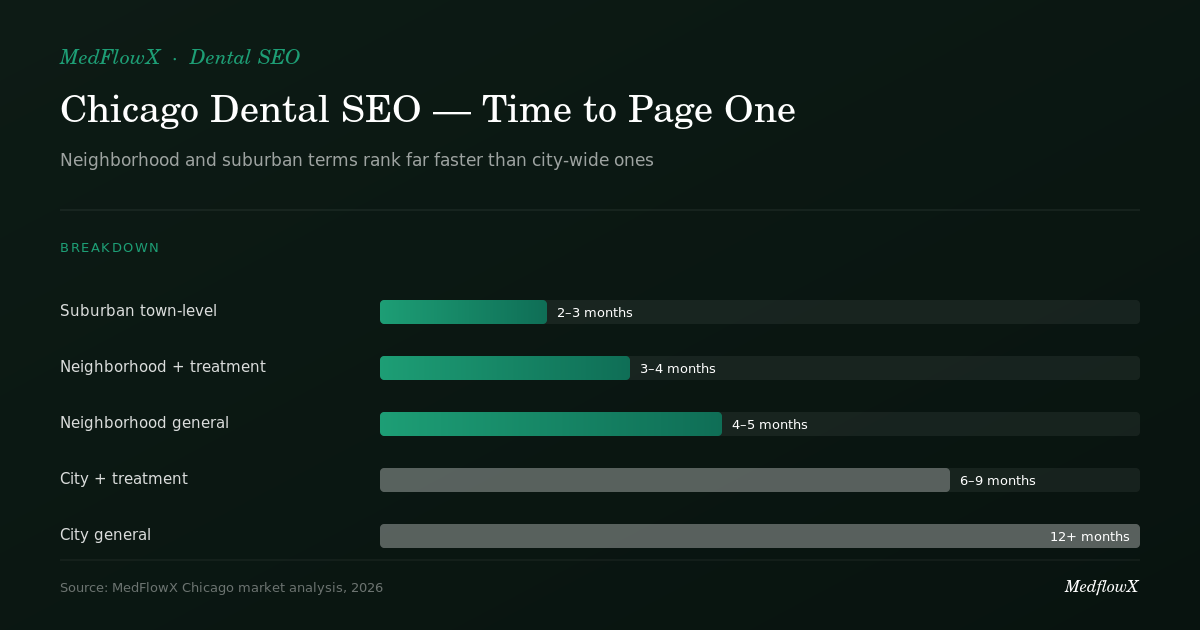
| Keyword type | Example | Time to page 1 | Difficulty |
|---|---|---|---|
| Suburban town-level | dentist Naperville | 2–3 months | Low |
| Neighborhood + treatment | Invisalign West Loop | 3–4 months | Low–moderate |
| Neighborhood general | dentist Lincoln Park | 4–5 months | Moderate |
| City + treatment | dental implants Chicago | 6–9 months | High — DSO competition |
| City general | dentist Chicago | 12+ months | Very high — not recommended as a starting target |
The sequencing that works: start with suburban town terms and neighborhood-plus-treatment terms, both of which produce visible movement inside a quarter. Use that early traffic and the authority it builds to move on neighborhood general terms around month four. Only attempt city-plus-treatment terms once the neighborhood cluster is ranking and the domain has accumulated real link equity. City general terms are a year-two objective at the earliest, and for most independent practices they are not worth targeting at all.
What makes this work is concentration. A practice that spreads a modest budget across five neighborhoods and three suburbs generates too little signal anywhere to rank. The same budget aimed at one neighborhood cluster until it ranks, then the next, compounds. Detail on how this maps to your specific market is on our Chicago dental SEO page, and the broader methodology is in our dental SEO services overview.
Frequently Asked Questions
What Chicago dental practices ask before committing to a marketing budget.
Chicago practices typically invest $1,500 to $3,000 per month for a single specialty in one neighborhood cluster, and $3,000 to $5,500 for multi-specialty practices covering both city and suburbs. Google Ads CPCs for dental terms run $6 to $11 per click here — lower than San Francisco or New York, but high enough that organic search remains the better long-term economics. At a Chicago implant case value of $3,800 to $5,200, one additional patient a month covers most retainers.
DSO-backed groups dominate them. Chicago has a heavier concentration of dental service organizations than most US metros, and those groups run multi-location sites with years of accumulated authority pointed at exactly the terms independent practices target first. An independent practice will not displace them on “dentist Chicago” inside a year. Neighborhood terms are a different fight — most have no dedicated page competing for them at all.
West Loop and Streeterville are currently strongest. Both have dense high-income residential growth, large daytime office populations, and almost no neighborhood-specific dental content online. Gold Coast and Lincoln Park carry higher search volume but meaningfully more competition. Wicker Park and Logan Square are underserved relative to their demographics, particularly for Invisalign and cosmetic work.
They are separate markets and need separate pages. City patients search by neighborhood and book near where they live or work. Suburban patients in Naperville, Evanston, Oak Park or Schaumburg search by town name and will drive further for a specialist. A single Chicagoland page serves neither well. Practices with locations in both should build distinct pages per market rather than one page attempting to cover the metro.
Neighborhood terms typically reach page one in three to four months. City-wide terms like “dental implants Chicago” take six to nine months against DSO competition, and longer without link building. Suburban town-level terms are often fastest of all — frequently under three months, because competition at that level is thin. Sequencing neighborhood and suburban terms first while authority builds toward city-wide produces the fastest overall result.
See exactly where your Chicago practice stands
Free audit covers your Map Pack position by neighborhood, the terms DSOs have left uncontested, review velocity against local competitors, and a sequenced plan for your specific location.
Get Your Free Practice Audit →